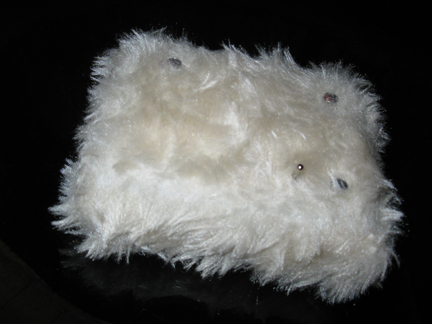
Expansion and contraction. Allow me to elaborate. After living in Costa Rica for a little over a year, with a pending international biennial on the horizon, as well as our wedding shortly afterwards, I realized that it might be time to start looking for some form of employment befit to my qualifications in anticipation of the next wave of expenses. We were in San Francisco at that time, living off proceeds from a teaching gig at my mom’s summer camp and an honorarium from our performance at the San Francisco Soundwave Festival, and, as those who’ve spent some time in the bay may know, things add up quickly and sooner than I realized, I was scanning the employment pages of a handful of east coast colleges, looking for anything commensurate with my experience. Call it a sign of the times, but there wasn’t much out there. There never is. In spite of that, Pau and I decided to part for a second – her returning to San José from SF and me taking the train east to catch up on some pleasure reading and be in situ in case something came up. Not to mention that it would be easier to procure the final components needed for our show in Panama. At this point, it was the end of August. Three months later, I was still in New York looking for… something amidst the foliage and family. Don’t get me wrong, I applied to my share of things, but the east coast is fairly barren, unless you’re interested in teaching early childhood development or have a doctorate in communications and are interested in teaching video game design. For the record, I’m not, I don’t and I’m not.
Finally, after weeks of searching, I found something that fit the bill. I applied, submitting my application in a downpour as Hurricane Sandy crawled up the coast. Two weeks later, I was on a plane heading back south by way of Houston. While in Houston, the phone rang, asking if I’d be interested in interviewing. I happily said yes, explaining that I had obligations in Panama in January and was waiting to board an international flight in twenty minutes, kindly requesting that they continue correspondence via email since my phone is off-grid in Costa Rica. They did, and three weeks and $160 later, I was back in the states, preparing for my interview, part of which being a 20 minute lecture on the digital media software of your choice. I chose Max/MSP, since its my digital software of choice, has an interesting history, and can be tailored to support several different aspects of new media art. My lecture itself focused on alternative interfaces and in-box data manipulation – starting with simple pitch tracking of an object and running it through the gamut until the entire class is controlling an interactive video environment within the course of 20 minutes. To assist with, and possibly provide a certain je ne said quoi to my lecture, I decided to create a couple objects for my class to interact with. Here’s what I did.
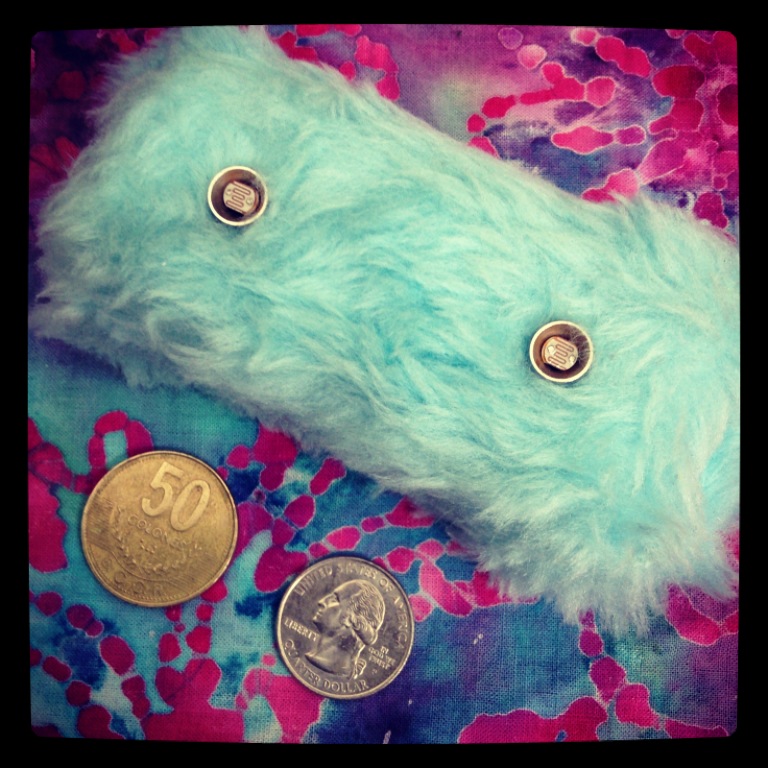
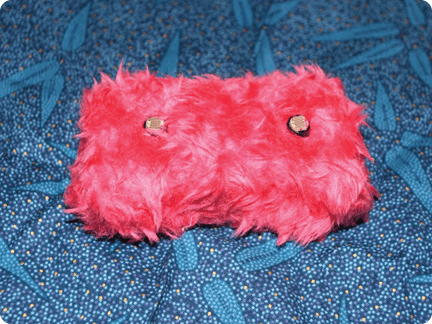
Before I returned to Costa Rica, I decided to redesign and rehouse my entire line of pedals to give them a more professional sheen and allow for standardized sharing of components across the board, generating a handful of pre-drilled shells from previous pedals that needed use – however, unless I was looking at simply presenting a couple hacked 24’s to the class, I’d need to perform some cosmetic surgery on these boxes. Fortunately, I still had a couple pounds of faux fur at my folks’ house, as well as a can or two of 3M 77 – 3 hours later and voila – technicolor tribbles. But what to house in them? Time and space were of an essence, so I decided to consult a couple electronics books for inspiration, among them Nicolas Collins’ Handmade Electronic Music – flipping immediately to the oscillator section, I decided to take a stab at his cascading square-wave synth, ordering a handful of 4093 IC’s and supplementing my build with components that I had lying around. At this point, most of my electronics were in New York anyways – I’d spent the autumn building and realized that Costa Rica’s economy is fairly slow until March or so, so there was no sake in bringing anything custom south if the main objective was just to sell the current stock while the holiday bonuses were still fresh. A couple hours later, I had my first prototype, using 4 oscillators with set frequencies wired to a master pitch control via a photoresistor tweaking the pitch of the first oscillator. It sounded relatively ok – your typical opto-theremin buzz. But I could do better. Working under my usual premise that most things sound better with a dying battery, I wired a second photoresistor to the master power supply and found with a little practice, you could actually produce a wide variety of sounds with it. Three of these boxes were made in total – one red (white with a red LED, actually – red fur is hard to find), one green and one blue, each corresponding to the channel of video it was intended to manipulate.
Unfortunately, I made a slight miscalculation with these boxes – namely, when it comes to impressing a hiring committee of a liberal arts college, don’t come in with your freak flag flying. While nearly every school touts innovation, they also want safe, dependable faculty able to shape the minds of their students to the proper standards commensurate with the merits of their particular academy, or something like that. Not some weirdo builder who comes to town with a couple furry boxes and a lecture that revolves around the concept that the tools are irrelevant provided that the idea is clear. In short, I should have probably waded through an intro lecture to Final Cut Pro, covering the same points as every other intro lecture from Final Cut Pro, trying to glance over the fact that college level education should be slightly more in depth than something that can now be learned in the back of an Apple Store four times per day. But whatever – good things did come from this – thanks to the college flying me in for my interview, I was only a few hundred miles away from a reward ticket on United, and, more importantly, it lead to further experiments with the 4093 IC, as well as the idea to teach a class centered around diy synth construction back in Costa Rica. More on that in future posts. In the meantime, enjoy the video I made of one of these little guys in performance.
A quick update on this as I port it from one website to another to fill you in on what happened to these boxes in the decade since that’s transpired: After pretty much bombing this interview, I left them with a friend who is more often than not the chair of the electronic music department at said school – and, over the course of the past 13-ish years has incorporated these things into his curriculum – so ten points for subversive tweaks to institutional pedagogy?
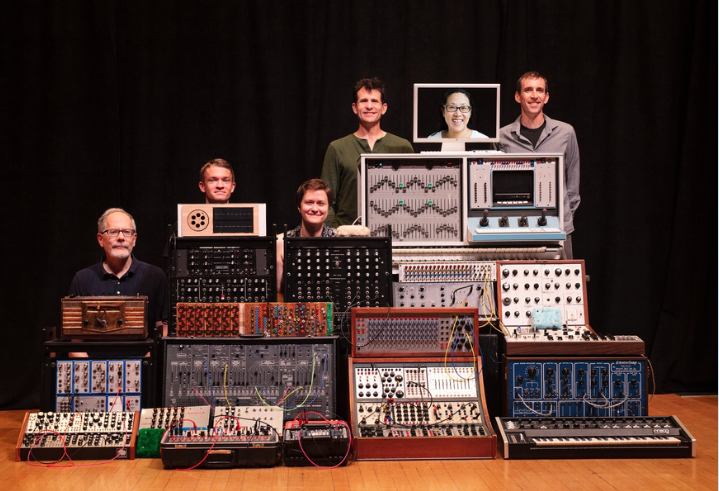
Speaking of, if you look closely, you’ll see these guys hiding among the TIMARA department synth collection as captured by the Oberlin Conservatory Alumni Magazine.
Media
A quick video of one of the initial iterations of this box. However, as I still had a fair amount of faux fur and people seemed to like these things, several others were made as well – here’s a quick recap:
Number 31 (2013)

I almost HAD to make this one, considering the circumstances. What I never expected was how ridiculously cute it would turn out. Here’s how it happened: In October 2012, Pau and I were putting the finishing touches on our piece for BAVIC and were at a loss for what to do for speakers in our sculpture. A few months prior, we’d swapped the discmen used in the original installation at BIENARTE8 for Arduinos driving WaveShields enclosed in industrial project boxes and were thinking about doing the same for our speakers. Unfortunately, there wasn’t enough space inside our boxes to mount both the Arduino and a speaker, so we decided to look for external solutions that could not only survive the rigors of international shipping, but also sound slightly better than the computer speakers we’d used in the last two installations of RARO. I was in New York at the time, and as is my wont, one of my usual New York activities involves sorting through my belongings in my parents’ basement, cataloguing, downsizing, eliminating and combining. With few exceptions, after every major adventure (college, grad school, that time I lived off grid in Colorado, second foray into the Bay Area and my upcoming return to the states after two years in Central America), I usually end up unloading my gear into 18 gallon tupperware bins on the understanding that I’ll sort through it later once I’m settled. This never happens, but eh, I try every time I’m home for about a week. I figure, what’s the point of having six boxes with various student loan info and tax forms, etc, when you can just have one large one… or something. Anyways, it was on one of these forays that I discovered a package of slim-profile multimedia speakers from a project I did at Mills that involved activating various pieces of resonant glass in a candlelit amphitheater at sunset, by way of these speakers, an ARP 2600 and a boatload of amplification. I think there was a camouflage net involved as well – flair for the dramatic, etc. 5 years later – box, basement. I was also researching alternative guitar pedal enclosures at the time and was intrigued by a couple tiny buffer pedals, so, curious about the actual size of the box and curious whether one of these unearthed speakers would fit in the enclosure I placed an order. It didn’t fit.
Fast forward. It’s now December – my time back in Costa Rica was just cut short via an important job interview and I’m back in New York frantically assembling 3 fur-covered opto-synths as supplemental material for a pending lecture on alternative interfaces and multimedia performance. This tiny box is still on my desk, along with supplemental materials left over from the three little furry oscillators.
Fast forward again. Now it’s February. Our installation at BAVIC is up and in effect, we’re recently married and a majority of our wedding guests have either returned to the states or are kayaking through mangroves on the Pacific coast and won’t be back for a few days. I’ve just unpacked my electronic supplies to see what I can offer for this inkling open-source synth class I’m thinking about teaching and Pau is sorting through fabric scraps left over from Panama to see which should be kept and which should be trashed. We’re usually relatively efficient when it comes to fabric use, so most of the scraps were scrapped, but there were a couple larger pieces that could still be used for… something. I look at desk. Small box, opto-synth guts, lavender fur-tailings. Had to do it. And two days later it was done.
Sonically, it’s pretty cool in spite of its simplicity – 4 oscillators with set frequencies are supplied by a 4093 IC wired in typical cascading fashion ala Handmade Electronic Music. One photoresistor controls the master power supply, the other controls the pitch of the first oscillator. Instrument can be played via a series of gestures, such as stroking, petting, hitting, hiding, cuddling, and so on. It’s kind of bass heavy for a little guy, but eh, what can you do.
Here’s two examples of the Tiny Furry Oscillator in use – one by me, the other by Pau – take ye listen and enjoy!
At the moment, this particular lavender creature lives with one Fernando Arce of the Costa Rican band aUTOPerro. I look forward to hearing what he does with it.
Production Builds (2013-2016)
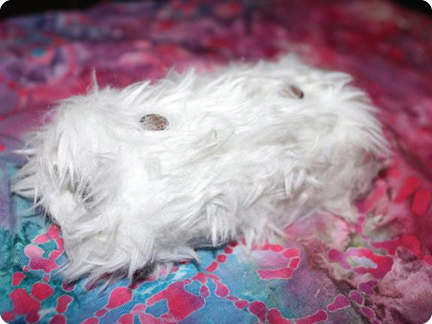
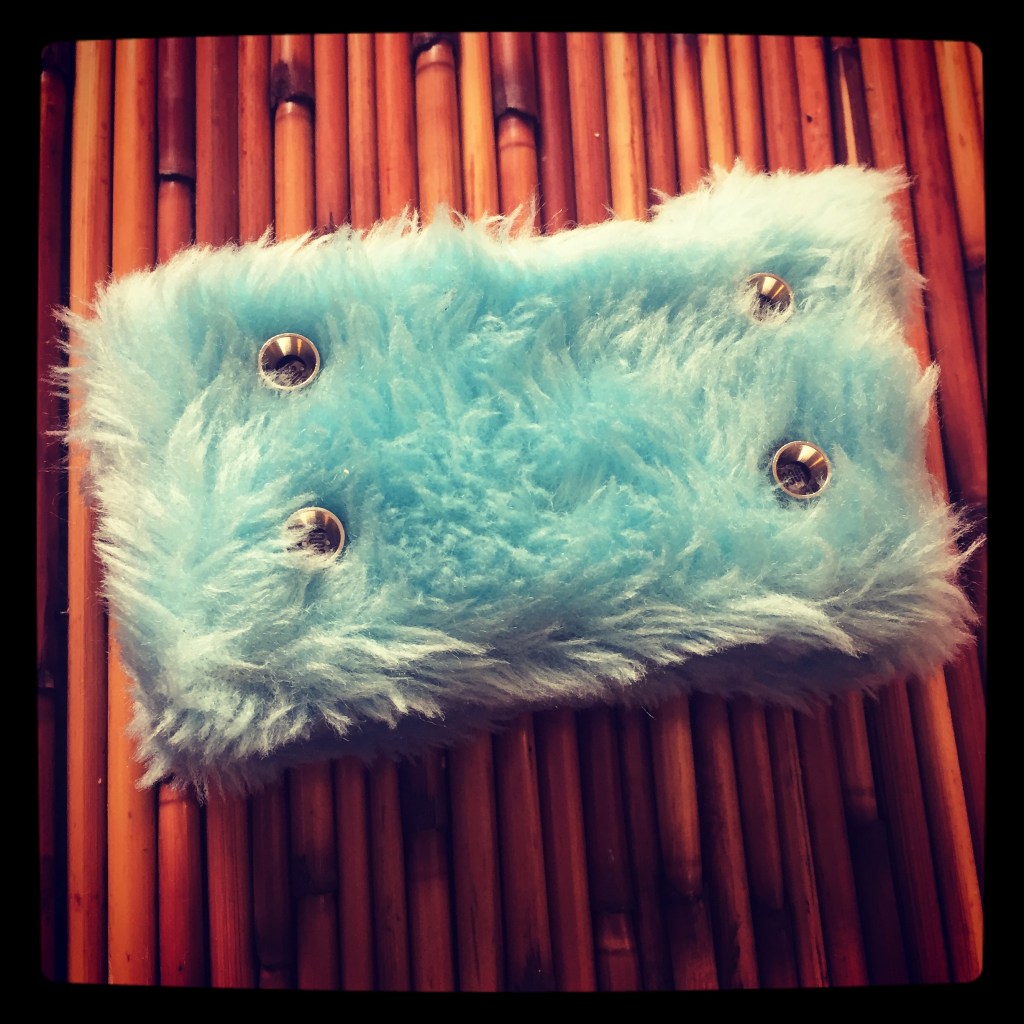
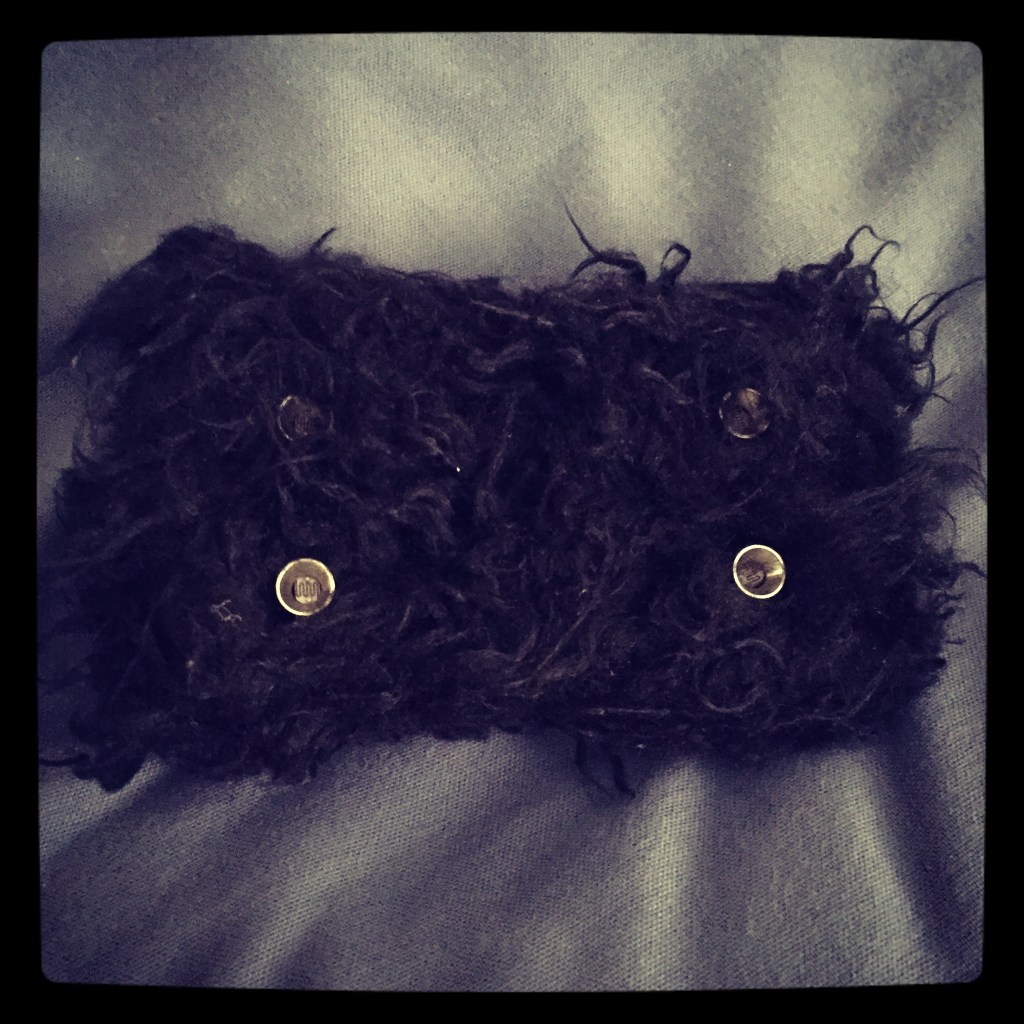
Documenting the next step in the evolution of small, oscillating objects commonly covered with faux fur. In this case, we’ve gone micro-production here. Considering the nature of assembly, each synth is unique, so we’ll do what we can to document them individually, BUT, at the same time, they are for sale and we will be producing them fairly often in a variety of colors, etc.
But first, a description, which goes a little something like this:
A Little Furry Oscillator from our current batch of trademarked space-poof inspired, handheld beep-makers ideal for those seeking playa accessories, harajuku harsh noise and possibly even a serious musician or two. A guaranteed 2.5 minutes of sheer multi-sensory delight awaits you upon sampling said critter – after that, you’ll have to get creative, which, I guess is kind of the point.
From a technical standpoint it’s a 4-oscillator, cascaded NAND opto-synth with controls over pitch and voltage sag. Combine these two variables together in a modified Northeastern gamer grip and go to town – I’m sure they’d love to hear your bird-songs outside the Cold Stone on 2nd and C.


Number 46 (2014)
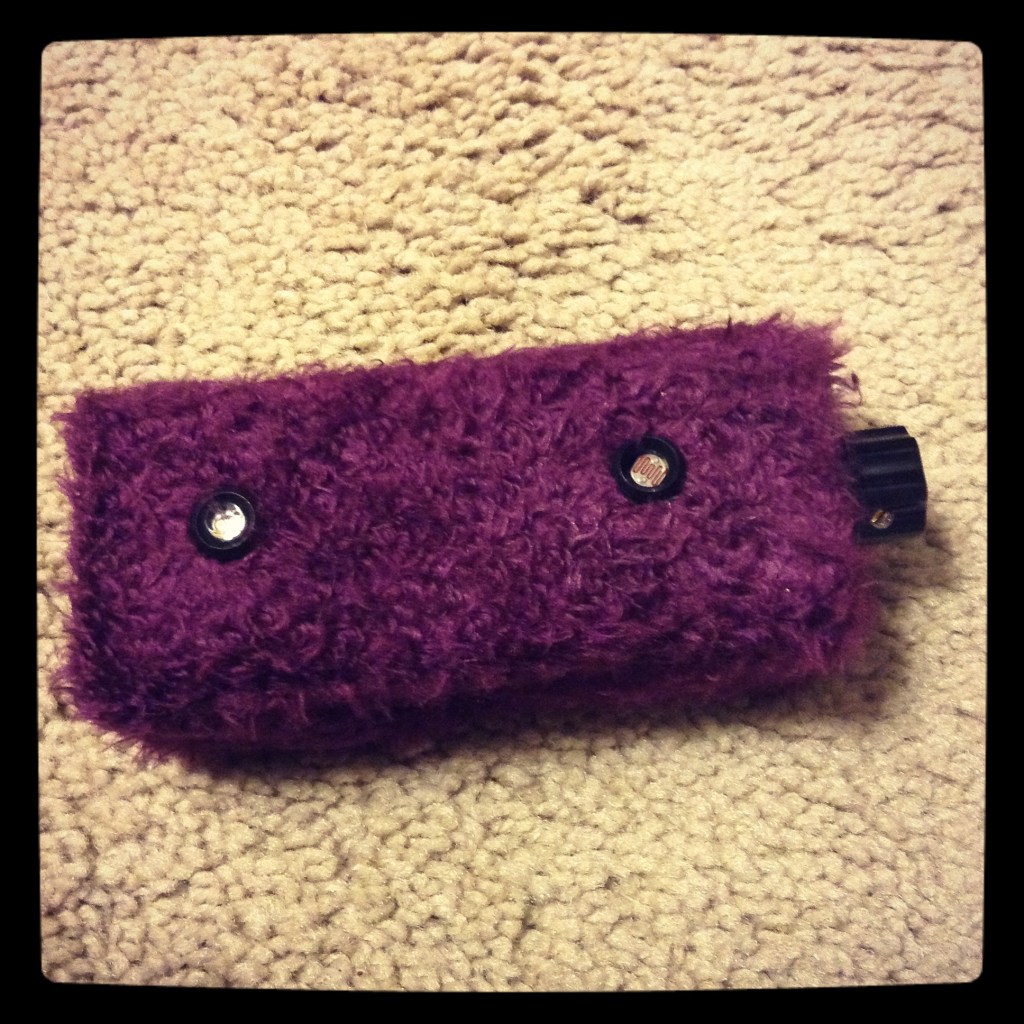
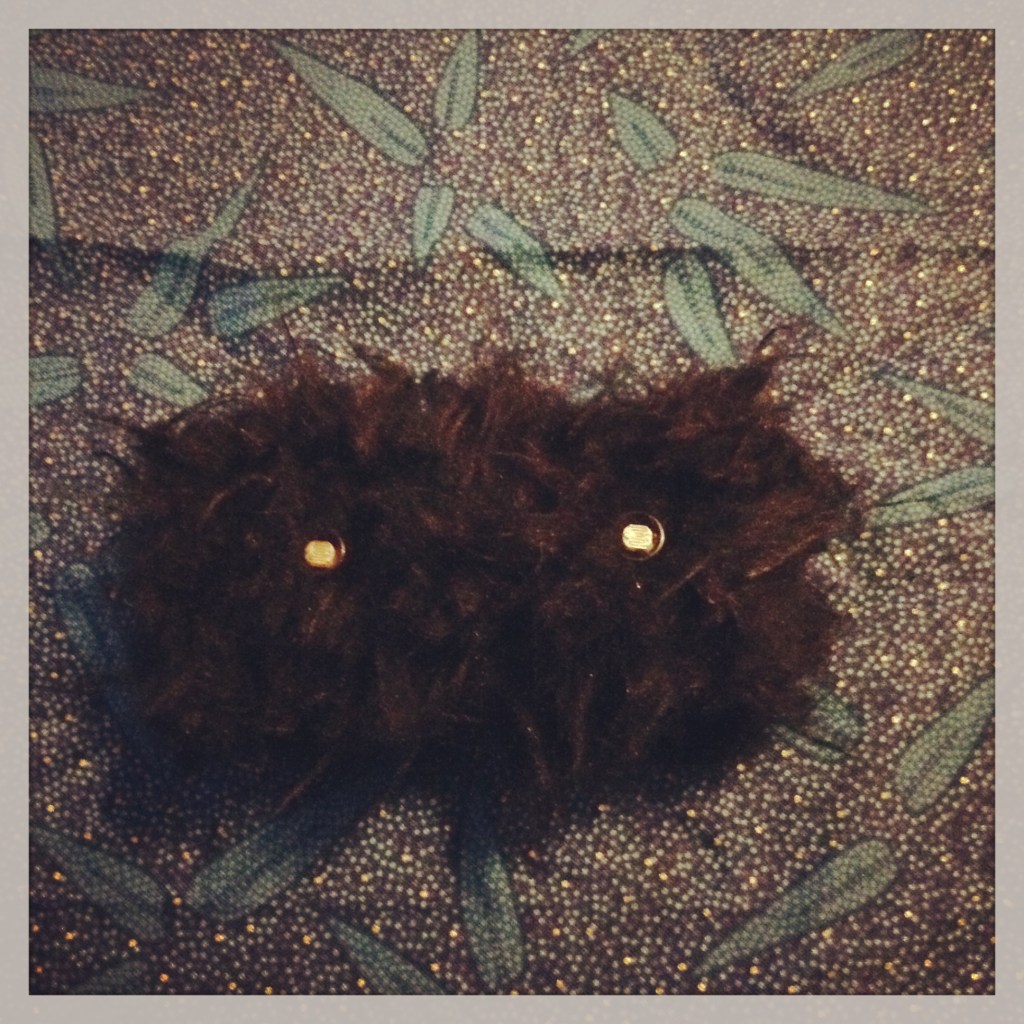
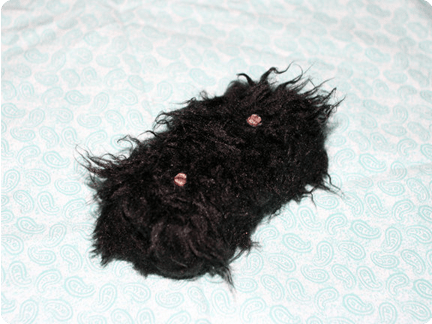
More of a modified Little Furry Oscillator than anything else, but it gets it’s own number given the rules of numeration, since it’s a unique object and derivates from the previous. In this case, the LFO circuit has been tweaked to allow for LED taps off each oscillator, as well as a potentiometer for voltage control. I built it as a birthday present for an old roommate who’s using it under the employ of the moniker Take Up Serpents.
 Hypermetacontextual