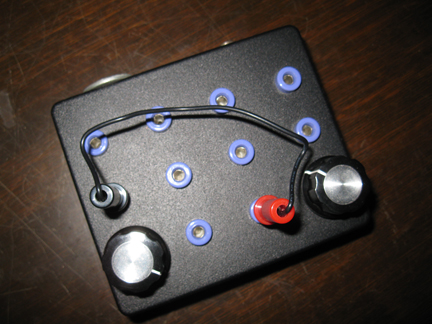
The last instrument built during my “California Era,” lovingly constructed in April 2011 for Liz Meredith, a composer, violist and good friend from Baltimore, Md. Internally, it’s a very small Ciat-Lonbarde Rollz 5 Drum Machine circuit, consisting of a 5 Rollz, a 3 Rollz and an Ultrasound Filter module and is capable of pulsing rhythms, the usual zombie-marches and a whole boatload of heterodyned noise and static. Actually, for a minimal interface, it’s actually quite versatile. Externally, the enclosure should look familiar – it’s actually the same off-size as the first batch of 23’s, which I would spend the next four months developing, designing and building at the beginning of my “Costa Rica Era.” Actually, the plan originally was to release the 23’s and then work on developing a circuitboard for something similar to this little guy – a small,pocket-sized modular synth of sorts. I may still do that, but I think I’d need another minute or two to develop something zesty. I love building Ciat-Lonbarde instruments, but while they’re fun to assemble, assembling point-to-point over pieces of plexiglass somewhat limits your productivity; not to mention that if you want to buy a true-deal CL synth from a series, drop the dime and buy one from CL themselves – it’s the least you can do to help support the flow of industry. But, in spite of that, it still would be cool to release a pocket-sized modular. I’ll get back to you on this one.
Revision
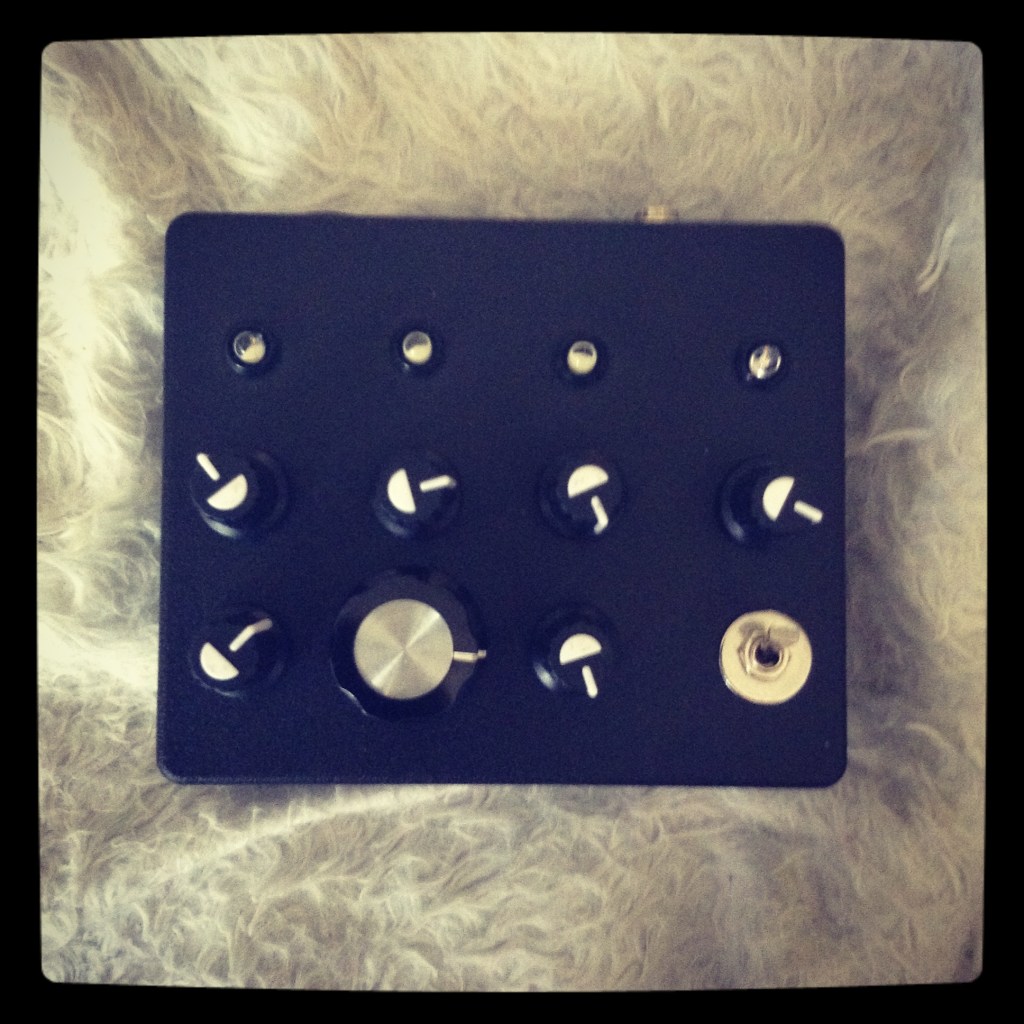
And then this happened. A few years later, during the onset of the “Baltimore era,” Liz stopped by looking for a couple more banana plugs to use this guy at a show. Being all altruistic, I offered to switch the polarity on the power supply to make this guy compatible with the usual guitar pedal 9v power supplies that power most things audio these days. Previously, I was using Radio Shack’s supplies on my builds, which worked well for mounting into bamboo on account of their overwhelming size, but could only really be wired center positive or they would short to the case of the unit. No wonder they went out of business. And lesson learned ala the whole concept of future-proofing your work: if it ain’t broke, don’t fix it, improve it, touch it, etcetcetc. Long story short, I’m still not sure what I did, but that synth went kablooey. Feeling horrible, I gave Liz a pile of other stuff to tide her over and vowed to rebuild and improve. What can I say – I do stand by my “If I can fix it, I will” credo. Thing is, this was right at the onset of Pau and I’s adventure known as pregnancy, so it took a little more than a second. In fact, most projects from that time took more than a second. In the end, this became two things. For the box – which I seem to be counting as just an updated Number 22 – serializing your work is strange – if it wasn’t for my urge to keep things ordered in my own noggin, I’d say just keep building and let some future scholar worry about the numbers. Hah, like that’ll happen. Or maybe. Word has it that apparently what I do counts as folk art/music these days – I write, chuckling inwardly. Yup. Inwardly chuckling. And compelled to note the absurdity of such an action. Back to the report. This is the update. The circuit’s completely different – consisting of a 4-step 4077 sequencer driving a 4093 cascaded oscillator at audio rates – meaning that it ends up creating a complex waveform instead of 4 distinct pulses. Then that’s run into a crude formant filter for fun and fashion. The guts of the original 22 became Number 48, whose build report can be found below.
Number 48
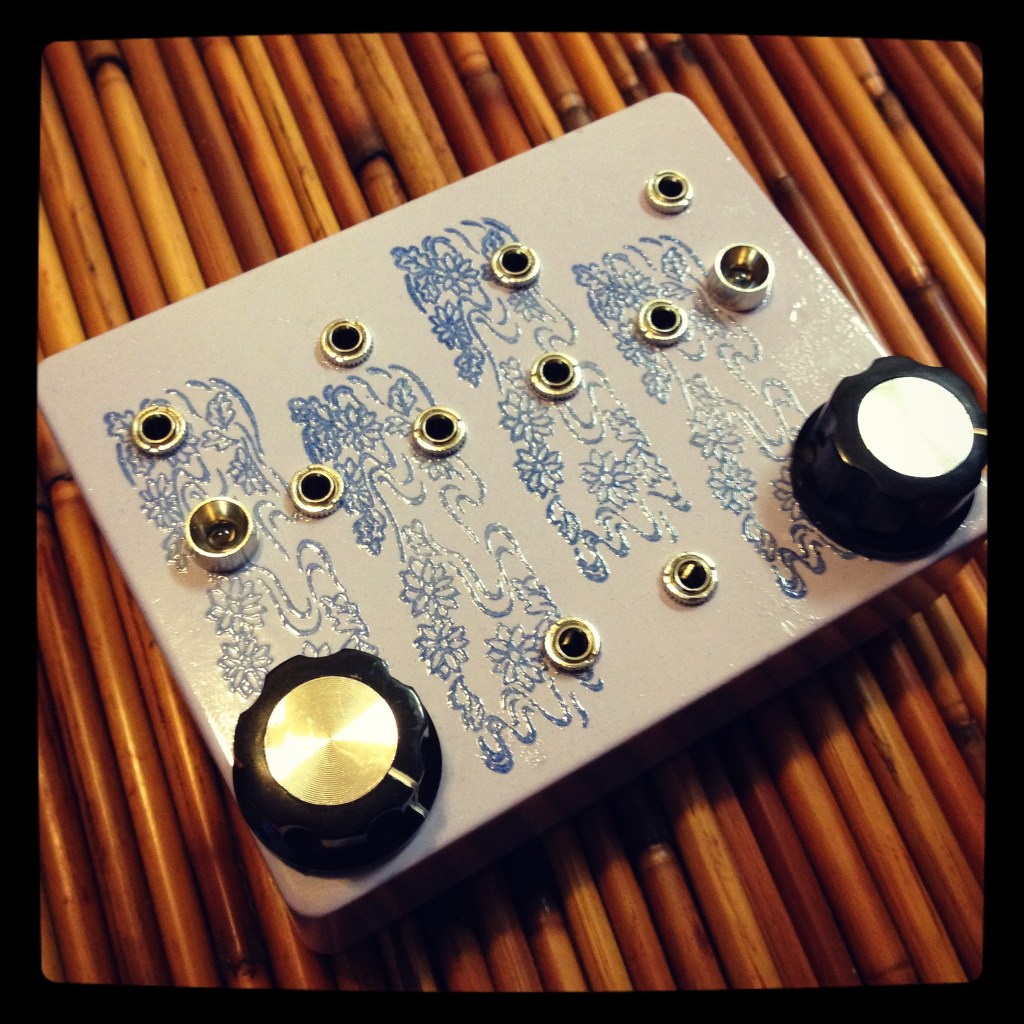
This is Number 48, otherwise known as the Errorscope. The original name was going to be the Periscope, but seeing as there’s some sort of social media concoction named as such, we’ve decided to go from something a little less liable for trademark infringement. Or something. Here’s how it happened:
Back in 2011, I built Number 22 for Liz Meredith shortly before I left California in favor of Costa Rica. In 2014, while in Baltimore, I offered to switch the polarity on the power supply to interface with a universal, center negative power supply, and in the process did something that Number 22 didn’t like. Feeling bad, since this was shortly before a gig, I gave her another synth and said that I would fix the box proper when I had a chance. Nearly two years later, here we go. Well, sort of. The insides are a little altered. The filter is still the same, but for the sake of space and experimentation, the actual synth section is something different. Instead of being a Ciat-Lonbarde inspired drum machine, it’s just a simple voltage divider, designed to take CV clock pulses and turn them into filtered pings. Or, if you run audio rate CV into it, it becomes a primitive ocataver of sorts that would probably work well with the proper sequence run into it. An added bonus of this box is that since it accepts control voltage as opposed to audio signals, it can actually be powered by just the CV input, giving the box an entirely different character than when running off the wall.
 Hypermetacontextual