Generation 1 (2011)
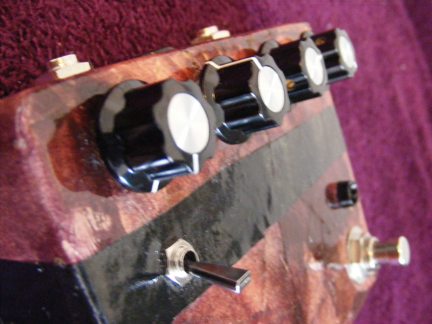


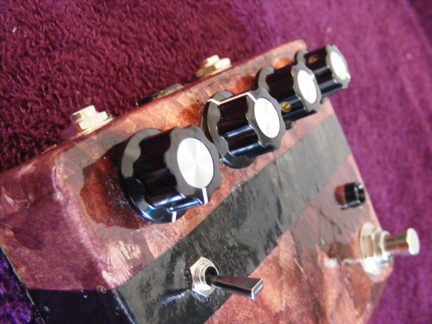
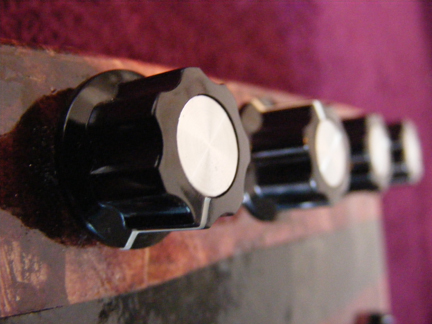
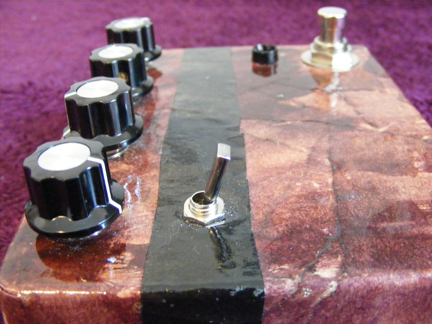
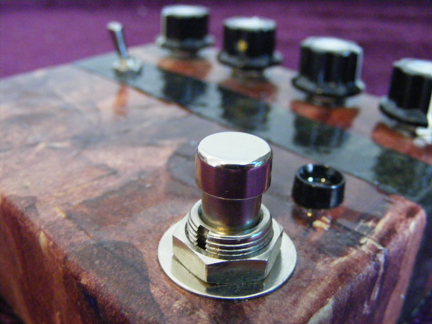

Number 23 was devised originally as a research project I embarked upon shortly after completing an experimental guitar pedal that combined aspects of the synths I’ve been building since 2008 with a boutique distortion pedal. Astonished with the elegant simplicity of the pedal I incorporated into the synth and seeking a chance to expand my knowledge of electronics, I began studying the schematics of rare, vintage and boutique guitar pedals, looking for similarities in design and clues to what made each one unique. Similarly, after years of building and expanding on designs sourced from a very specific vein of electronics, I was seeking the challenge of working in a different field – one where the emphasis of design relies on simplicity, as opposed to networks of chaos. Additionally, another challenge for this particular project lies in the field of replication. With previous instruments, each one was viewed as a unique instrument, and were numbered accordingly. While sequential designs tended to be similar in layout and application, each one differed slightly. With Number 23, this is not the case – transistors are matched, circuits are etched, potentiometers have specific functions (as opposed to my explanation of “well, they do something…”) and voltage is stabilized – not to say that it’s not wild, it’s just different. And capable of being replicated in small batches.
So what is it exactly? Well, it’s kind of very strange fuzz pedal whose design is based off a rare, vintage guitar pedal called the Ampeg Scrambler, which was originally released in 1968 to less than stellar reviews. According to legend, less than 2000 original units were produced before Ampeg shifted gears and moved onto more lucrative ventures. However, owing to the small numbers of the original batch, as its general regard as something different, originals are now bought and sold at astronomical prices and legions of DIY builders have done their utmost to provide several viable clones of this box, most of which claiming to be an exact copy of the original. For Number 23, this is simply not the case – however, I still haven’t answered the question.
So what is it exactly? At it’s core, it’s a relatively un-gated fuzz pedal tuned to spit out frequencies slightly lower than your typical ’60’s fuzz guitar. In fact, playing on the lower register of the neck produces tones that recall aspects of drop-tuned sludge and doom metal. However, as you work your way up the neck, the harmonics are “scrambled,” much like the namesake of the box that this one is based off of – the result: strange ring-modulated warbles emerge and take precedence, creating sounds that could be better described as robotic alien freakouts, as opposed to viable guitar tones. This is due to the use of darlington transistors in place of traditional NPN’s, paired with modern silicone diodes, allowing a slightly sharper, aggressive sound with a couple ghosts in the machine thrown in for good measure as signals are amplified and buffered in a less than traditional fashion.
But wait, there’s more – outside of a modern interpretation of a rare, vintage pedal, there’s a couple additional tweaks built into this box. First, there’s a matter of voltage. With this edition, voltage can be dialed in to the user’s specifications. Unlike several gated fuzzboxes available, where starving the voltage creates abrupt, sputtering effects, this is not the case. Instead, it acts more as a delay for the effect, slowing the attack to the point where the blend between wet and dry becomes a dynamic element that ranges from a slight, ramped buzz to a full sonic assault. In this way, subtlety is key. Of course, being one who values a well-balanced approach to sound and electronics, opposite the controls for subtlety are the controls for the crazy – a fully controlled feedback loop that realigns every potentiometer on the box to something a little beyond the role of a traditional guitar pedal, ranging from a slight howl, to a robotic seizure to a massive, no-input beast that responds to every pedal tweak before it in the chain – versatility, as always, is key.
So there you have it – vintage design mixed with modern aesthetic, all wrapped into a small, individually-assembled, hand-painted box, produced in small batches to ensure quality, as well as to allow for modifications and improvement between runs. Batch number one is currently hot off the iron and ready for shipping. Outside of the pedal, each box shipped in a hand-sewn purple fur carrying bag (easily modified to put more fuzz in your fuzz pedal), a snazzy lino-cut user manual and a tiny stuffed friend to keep it company on its journey. That said, we invite you to do what you can to support small businesses, diy aesthetics, anti-corporatism in the arts and quality craftsmanship to boot, all provided at a fair price. As always, operators are standing by.
Alternate Builds (2011-2012)
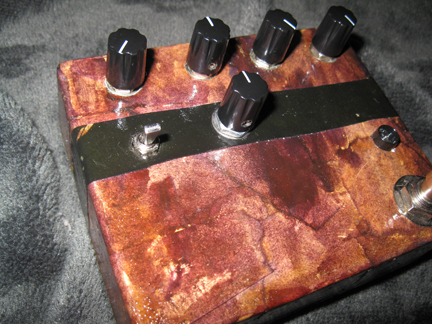


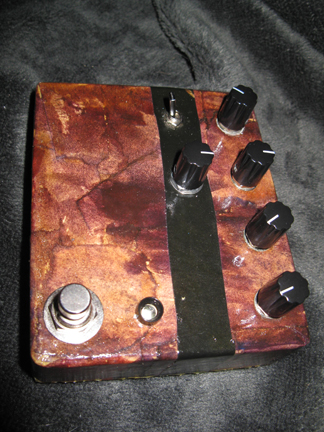

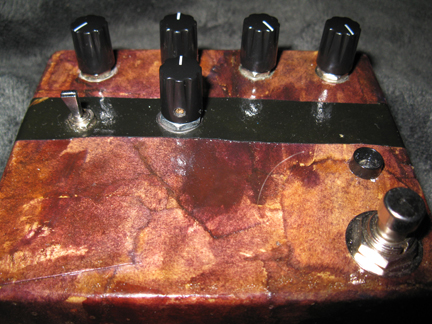
MK I: A custom first-generation Number 23 with an alternate set of clipping diodes and added boost. This one lives in Iceland under the employ of Gudmundur Steinn Gunnarsson.
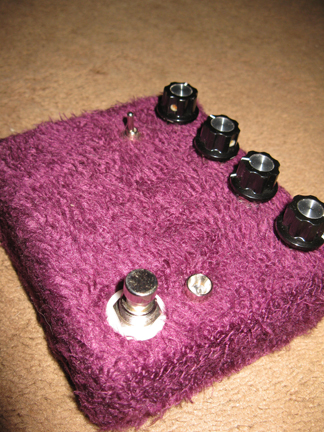
MK II: A trip further down the faux-fur covered rabbit-hole, this time featuring a modified Number 23. Other than re-defining how literal one can interpret the word fuzz, this box nixes the voltage sag that was included in the first batch of 23’s and instead replaces it with an additional boost to assist with those moments when loud just isn’t enough. Similar to 23 Mk I, I also decided to experiment with different combinations of clipping diodes, eventually settling on a combination of a silicon diode and a pink LED. The resulting sound ends up being much harsher and metallic than it’s predecessors, but in all, I think that’s a good thing.
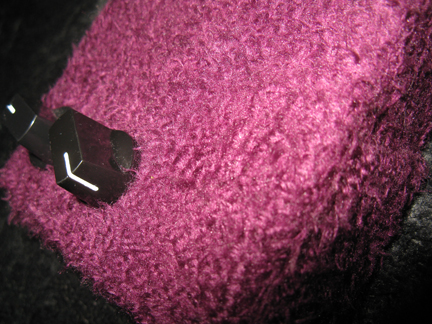
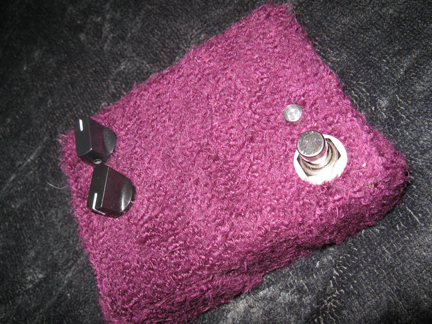
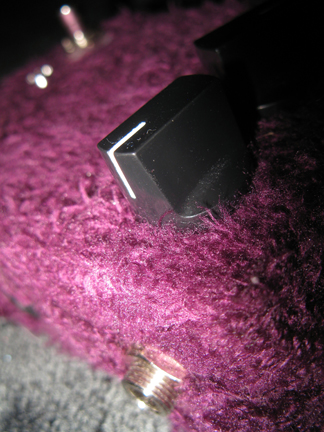
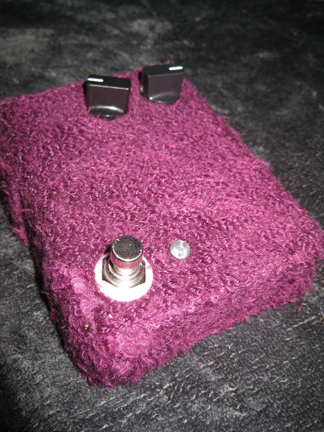
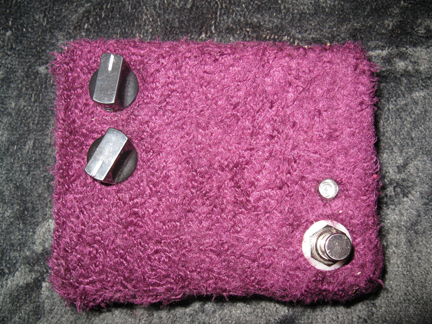
MK III: The “Blue Martian” – A stripped-down 23 with only a volume control and a switched feedback control. Currently in the arsenal of Erika M. Anderson.
Generation 2 (2012)

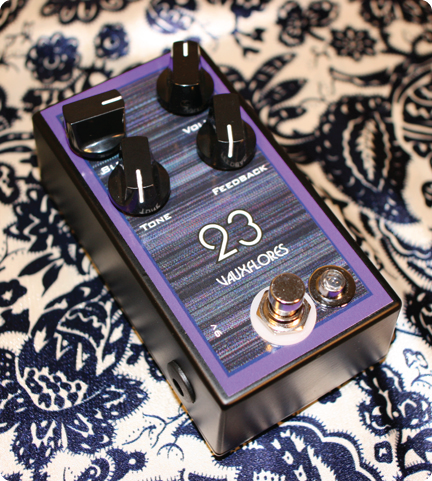
About a year or so into production building, it became readily apparent that hand-collaged boxes without any labels or branding probably wouldn’t fly in the cutthroat world of boutique guitar effects. Not to mention that people apparently like top-loading jacks and standard-sized enclosures and whatnot. So after parting with the inaugural batch, it was back tot he drawing board. The came by way of vinyl adhesives sealed with clear-coat, as this was before the era of turnkey UV printing solutions for metal boxes and it was easier to work with full-color stickers as opposed to waterslide decals or epoxy-based silkscreens when you’re largely living out of a backpack in between two countries. Ala controls, they got a glow-up as well. Gone was the voltage sag pot since people don’t seem to like DC voltage crackle in their boxes – while added was a switched pot for feedback control, as well as standard-sized knobs sourced from pedal-specific suppliers as opposed to larger industrial component distributors. I also switched from UV LED’s to a standard white LED that could be used across all production builds so better stretch out components. In all, this iteration lasted about a year or so until we returned to the US and decided to streamline things a bit more considering the whole general change of scenery and lifestyle we were going through as newlywed immigrants in a new city with a baby on the way and whatnot. Oh right – I also added a traditional volume control to this thing because word has it people like said feature.
Generation 3 (2013)
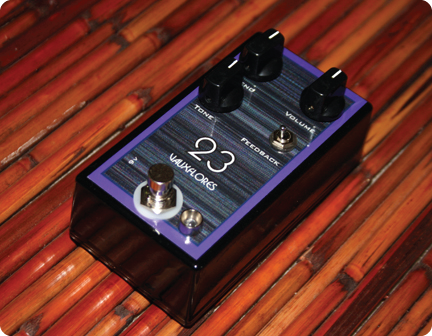
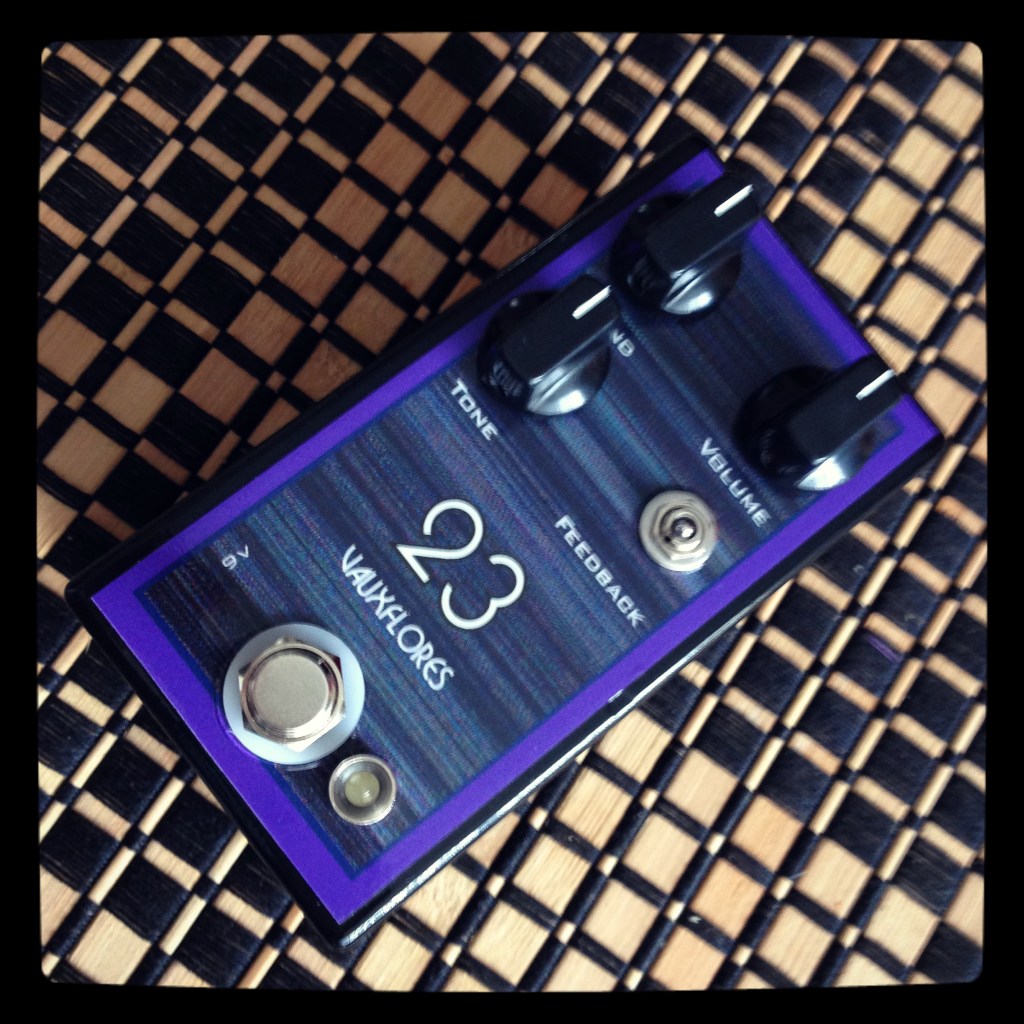
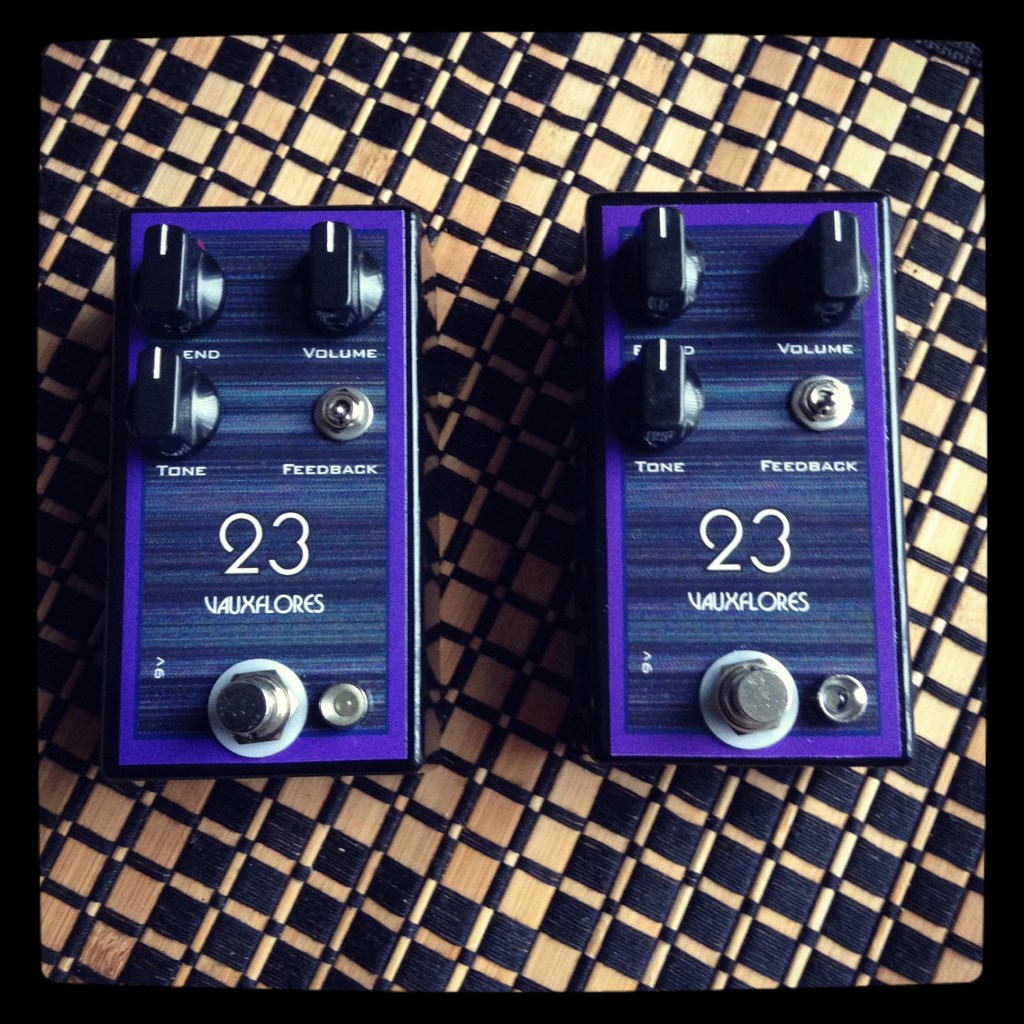
Easily the most iconic rendition of this box – considering how dynamic the controls are, I decided to nix the switched-pot feedback control for a simple switch for ease of use and wiring. This iteration was in rotation from 2013 until 2018 or so – basically until we moved from Baltimore to Ithaca and I had a second to re-tool the circuitry and layout to accommodate for my even more precious free time. It was also around this iteration that I began sealing the adhesives with bio-based epoxy as opposed to clear coat since it was a stronger, less toxic alternative – always a good thing when you’re both rocking an apartment and expecting a kiddo.
Number 56 (2017)
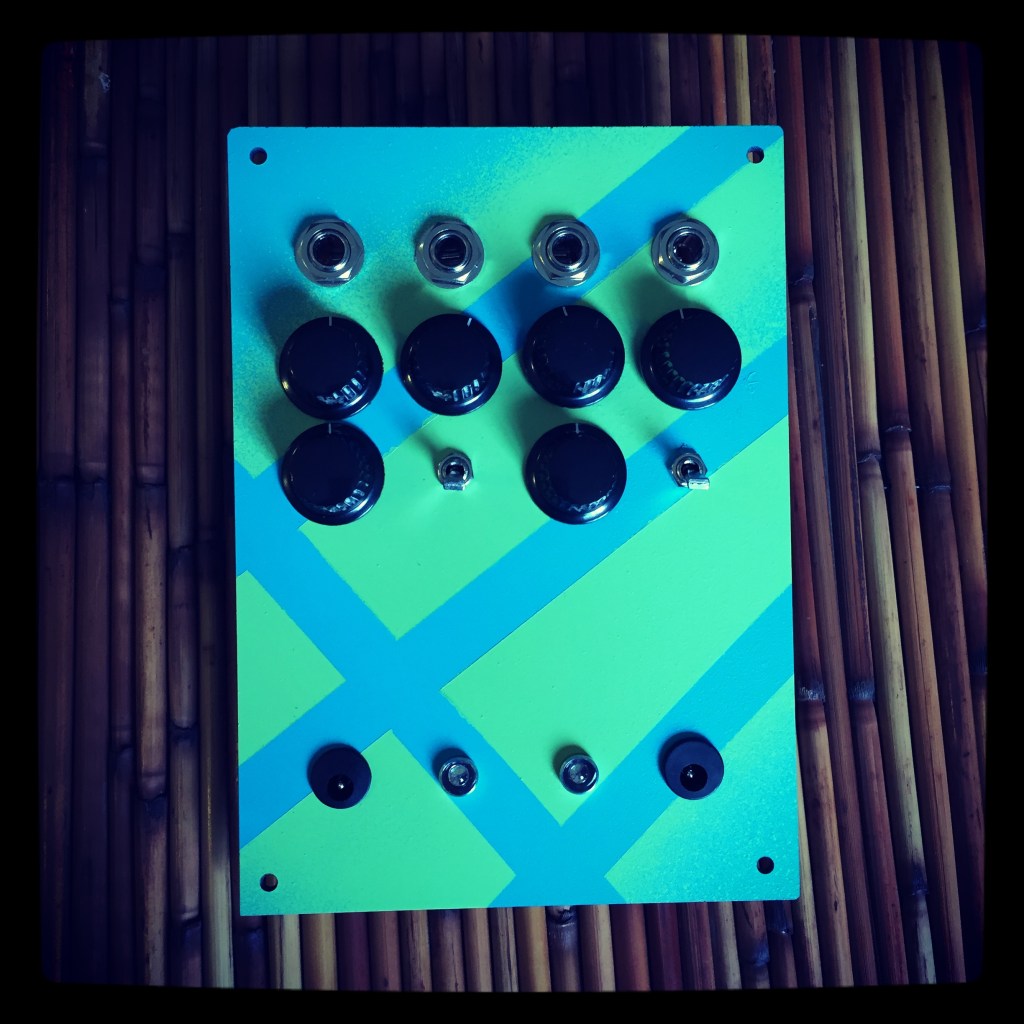
Number 56, AKA Industrial Panel Number 3. Code name: Zombie. I know – kind of a departure from the whole pedal aesthetic but around the time that I built it, space in our apartment was beginning to be a bit of an issue and we really lacked the storage for bins of pedals so the thought was to make compact panels of various effect units and other processors that could either utilize wall space or be mounted in standard-sized enclosures that could be more-easily stowed away when not in use. In the case of this one, it consisted of two Number 23 circuits mounted behind a 7×5 inch piece of plexiglass. I used it fairly heavily for a good slice of 2017 prior to moving to Ithaca but not much after. During the pandemic, I revisited the whole “we really don’t have space for pedals” vibe when the three of us were trying to manage work, school and teaching from basically the same space, which, when combined with newly-acquired knowledge of Eagle, lead to the creation of the Number 23 Eurorack module.
Generation 4 (2021)
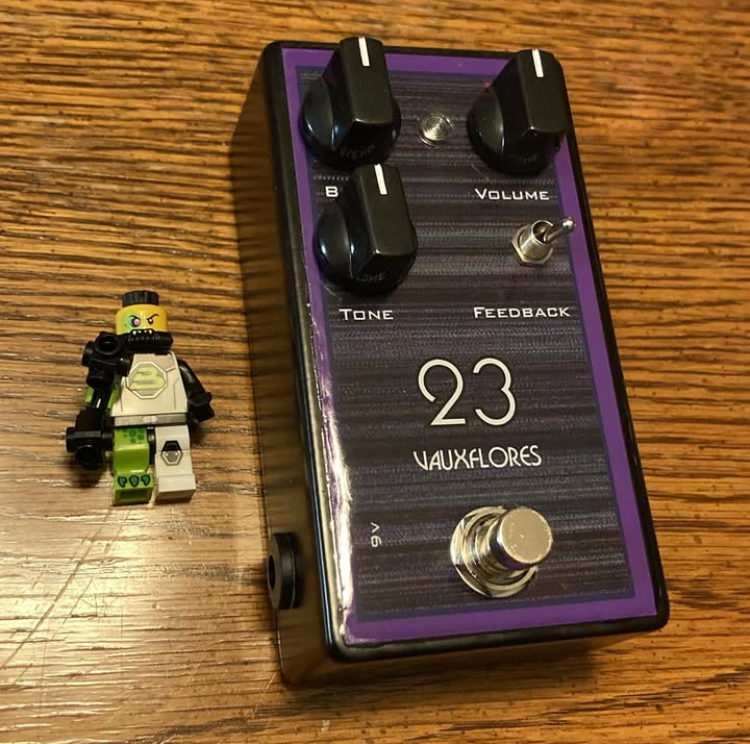
During the pandemic, I took advantage of our newfound abundance of free time to finally revise this critter. While the external appearance is largely unchanged outside of a fresnel replacing the LED bezel, the interior is an entirely different beast altogether – case in point: a better PCB with board-mounted potentiometers, as well as a board mounted status LED. Jaxks and power are still free-floating but the switch is potentially able to be connected via ribbon cable if the spirit moves. Likewise, I tweaked the values on the blend mode to allow for more readily available pot values – always a good thing in the following era of extreme supply chain shortages.
Eurorack (2021)

At around the same time that I was working on the 4th iteration of the 23, I also ported it to Euro, primarily out of size considerations – when you’re living under lockdown, space it at a premium and you’re somehow neurotically compelled to build things, you might as well explore a solution that offers the same sound at a fraction of the footprint.
Miscellaneous

This one was a 2021 pandemic build for Alex in CR.
 Hypermetacontextual