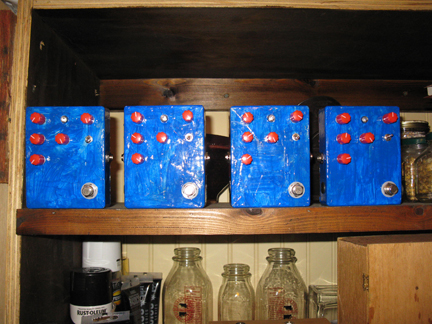
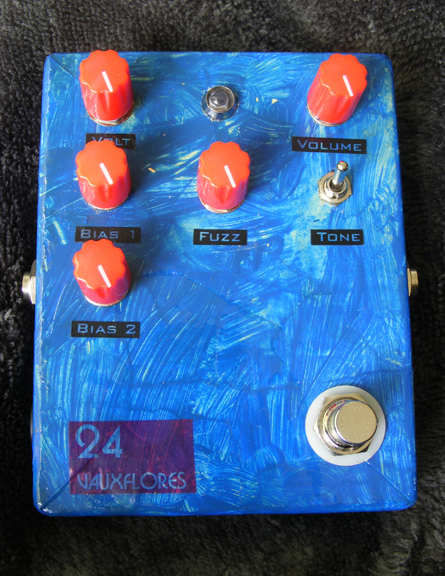
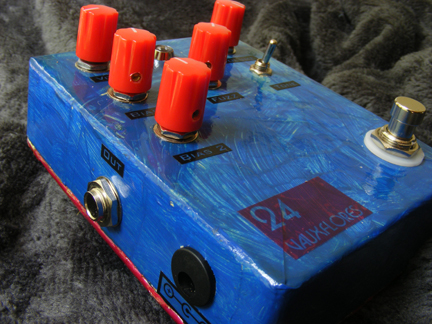
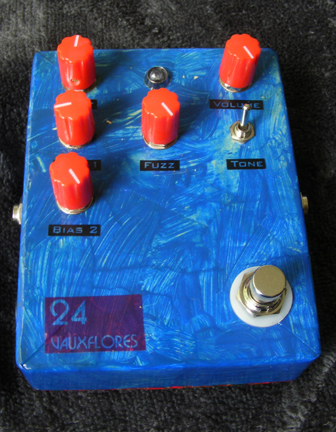
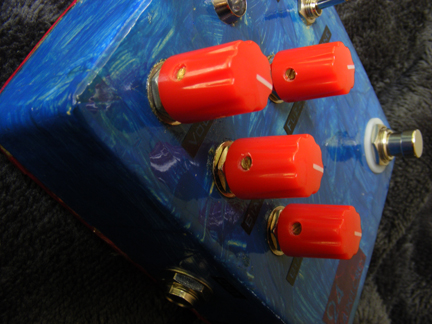
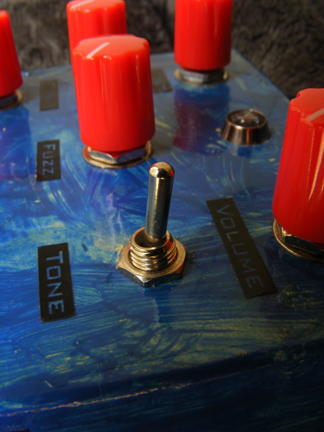
Generation 1 (2012)
VauxFlores’ second venture into electronics production, now available in full technicolor splendor! Ladies and gentlemen, introducing Number 24. At the risk of one of my usual essay-length descriptions that my electronics blurbs tend to be, I’ll try to keep this straight to the point, hopefully without tangential ranting.
So what is it?
Number 24 is a high-gain three-transistor fuzz that’s similar to several other boutique fuzz pedals on the market, but designed to be easily produced using locally-sourced materials. But wait – locally-sourced materials – like, hobbyist grade? Aren’t high-end boutiques supposed to tout obscure components and arcane combinations of rare Soviet-grade tank electronics and audio-grade flux-capacitors? Sure, yeah, sometimes, if they’re available. Do these combinations change a circuit’s sound from commercial blandness to some sort of creamy, psychedelic tone wonderment? Eh, why not. Are they necessary to produce an extremely-versatile unit capable of several unique tones housed in a single box? In this case, not so much. Allow me to elaborate.
At the moment, I’m currently living a bit of an international lifestyle, bouncing back and forth between my home state of New York and San José, Costa Rica, but for the sake of argument, let’s focus on San José as my primary residence. For those unfamiliar with the city, or perhaps under the influence of Lonely Planet’s horrible reviews of just about every part of Costa Rica that doesn’t involve midwestern-chic, beaches or yoga retreats, San José is a pretty cool place with a thriving music scene. Musical tastes range across the spectrum and due to the city’s size, the scenes overlap considerably and very seldom do we suffer from a lack of activity, creativity or any other descriptive noun ending in -ity. However, one thing that Costa Rica does lack is a local manufacturing base, which shows in the fact that outside of coffee and agriculture, our second-largest economic resource is tourism. Meaning, unless you happen to be involved in one of the few larger trans-national production enterprises here, or are an exotic butterfly, most of your wares will have to be imported to the tune of a fairly sizable import tariff. In the case of us musical folk, this is a fairly bad thing, since it drives up the price of commercial audio gear considerably. Same goes for the boutique scene, and in my case, all the aforementioned fancy Soviet-grade tank-capacitors, which are hit with an even higher tariff, since they’re considered construction materials. As a result, the local market for boutique audio wares is limited, to say the least.
Hence the decision to go local. Another quick note on San José living: very seldom do you ever find everything you’re looking for in a single place. More likely, to assemble a single bill of materials for a box you’ll end up visiting five different places, each offering something similar to what you’re after, leading to a lot of patchwork on the part of the builder, as well as a degree of flexibility while prototyping. In short, improvisation is key, or at least something akin to that old saying about horseshoes and various military-grade explosive devices.
Back to the box. Once the materials were assembled, it was a matter of designing a circuit that would be able to produce a wide variety of tones using components that were common enough to prevent wild goose chases or the risk depleting supplies of anything considered regionally unique. To do so, individual bias controls were incorporated into each transistor, effectively creating three individual fuzz controls for the box that react differently depending on the settings of their counterparts. Similarly, a voltage sag was incorporated as well, creating a plethora of tones at different voltages, ranging from tin-can telephone chirps to barking square-wave surf-safaris invoking doom metal bellows from a modular synth. Twist a knob or two to bring out a wall of feedback with a couple low-octave sputters and another to change to a subtle overdrive. All said, the range of sounds are pretty amazing. But don’t take my word for it.
Fur-Covered “Special Editions” (2012)
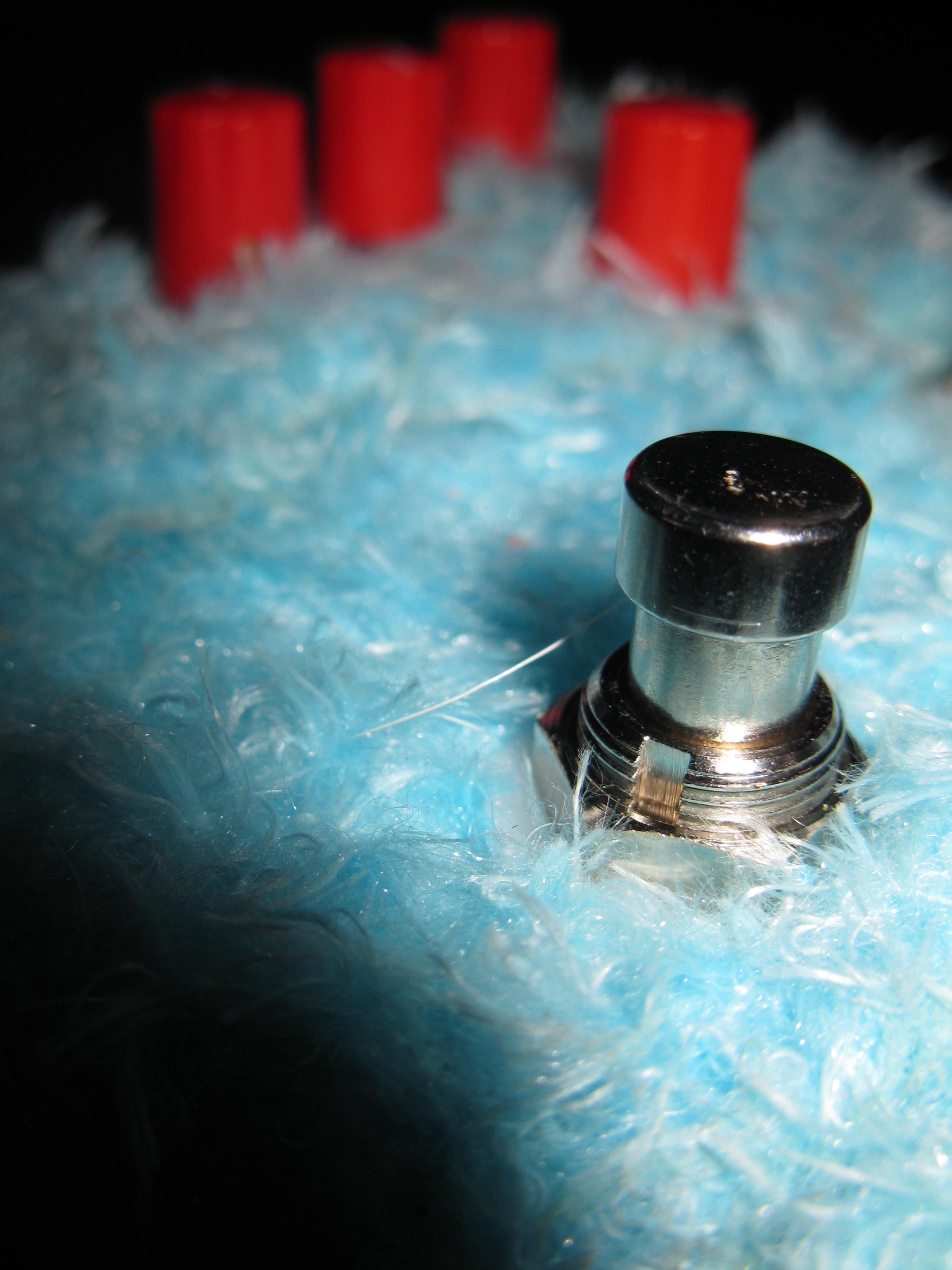

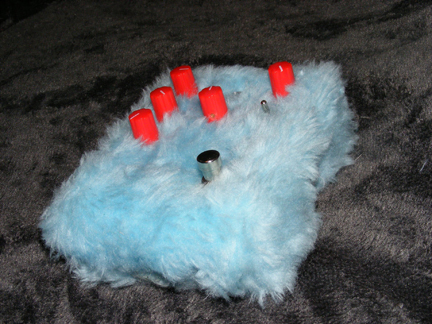
Electronically, this box is pretty much identical to your average 24, albeit with a different skin on the outside; formulated primarily to continue working the fur angle, as well as offer my wares in places other than my own site without running the risk of providing competition for myself. An interesting side-note for this one regards the availability of faux fur in sub-rural communities. Unlike San Francisco whose drag community necessitates the availability of nearly any fashion choice that could be considered ostentatious and Costa Rica, where a portion of society still takes pride in making their own clothes, Upstate New York… uhm, yeah, not so much of either – that I know of, at least. Either way, the availability of blue fur, not so much. As horrible as it sounds, in order to gain enough fur to cover this pedal, I uhm well, I skinned a plush Easter Bunny. I’m not exactly proud of this, but eh, maybe one day I’ll sew said rabbits face onto some sort of 3 meter long plush Bolivian Sand-Worm recreation or something – we have the technology…
The second Number 24 also came from the NY workshop, but this time adorned in fur brought with us from our studio in San José. Gotta say, it’s a whole lot nicer working with larger swaths of the stuff that can be cut to form, as opposed to gutting a toy rabbit – oh the joys of amateur taxidermy or something. Like it’s predecessor, the electronics are still an untouched 24, but hey, this one’s got fur – how could you go wrong?
Generation 2 (2012-2018)
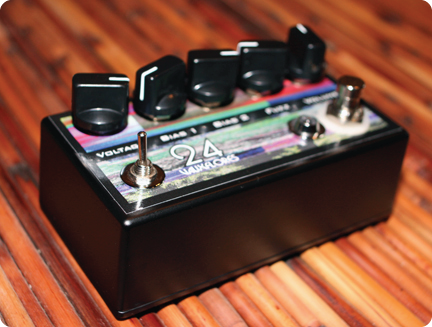
It should be stated for the record that trying to production runs of unique, unlabelled, hand-collaged boxes can be a little time-consuming. So, along with Number 23 and the soon-to-be released Platano Verde, I holed up at my parent’s place in New York for a good chunk of the fall and redesigned the entire line to share components, utilize a standard-sized enclosure and take advantage of adhesive vinyl labeling to make things easier on myself, as well as ideally churn out a more professional-looking product.
In the case of the artwork, I employed a data-bent image that was partially created using audio from the box itself. When not constrained to the dimensions of a guitar pedal, it kind of looks like this:

Coincidentally, more about this series can be found here.
Generation 3 (2018-2020)

While the external layout is essentially the same, this is one of the first builds of mine that utilized board-mounted pots and an upgraded, Eagle-designed PCB – not to mention UV-printed graphics instead of a vinyl decal. These were used in a couple workshops in NY and DC with the thought of doing a production run shortly afterwards. Unfortunately, the company that supplied the enclosures, as well as a majority of my pedal hardware went bust and for a good second my general build aesthetics were in limbo since my options were basically keep things DIY, go full turn-key or quit. Or, as it actually happened, have a pandemic generally mangle large swaths of society and use that as a good place to pivot to other ventures. In the initial stages of the lockdown, I did redesign the board one more time to a vertical orientation that would allow for a more standardized build across the VF line but never actually had them made since by that point, I was already knee-deep in modular synth stuff. Speaking of…
Eurorack (2025)
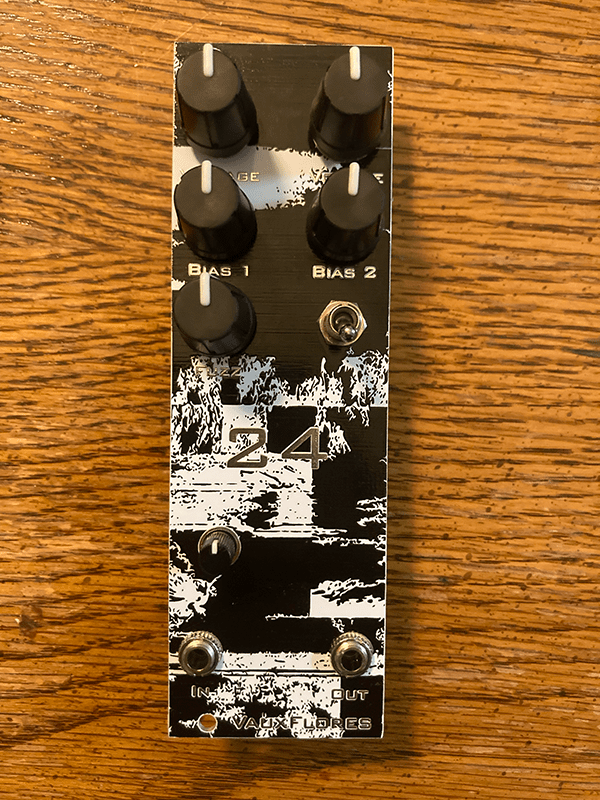
Somehow what’s old is new again. But smaller. And possibly more refined? At the very least slightly more adapted to my current aesthetic and current need for optimized space usage in and around the house. Ladies and germs, the new and improved VauxFlores Number 24 – A high-gain, three-transistor fuzz originally designed to utilize components common to San José, Costa Rica, yet equally common over a decade later in Ithaca, NY. Looking for a compact effect capable of going from a slight buzz to full-blown insanity with the turn of a knob? Look no further, this one’s for you.
Originally introduced in early 2012, the 24 boasts a variety of features, including:
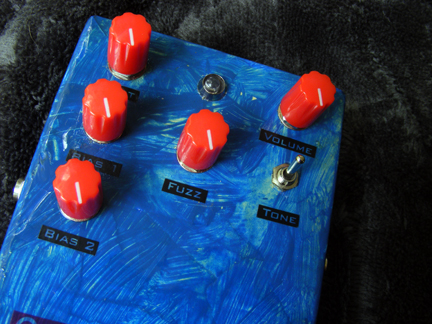
- Individual transistor bias control for maximum versatility, ranging from a mild overdrive to bit-reduced chainsaw madness.
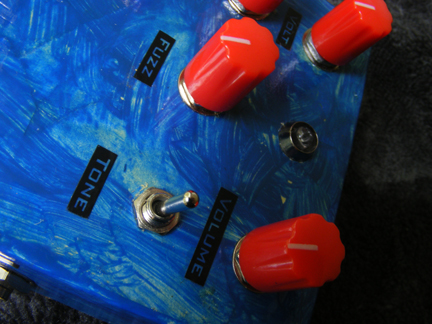
- Tone switch providing two separate tone paths, making this box equally suited for guitar, as well as bass, tuba, alpenhorn, synthesizer and amplified whale bones.
- Also sounds great on x0x sounding bass drums for those into the whole hardcore gabber thing. Or so I’ve been told.
- Voltage sag for those into sputtering weirdness and energy conservation.
- Artwork derived from data-bent imagery and audio signals, including sounds produced by the 24 itself – so in a way, this pedal had a hand in generating it’s own artwork. Because why not?
However, as this is some sort of European rack-based thingy, there are features that is doesn’t have, namely control voltage. It’s a distortion. Or maybe a fuzz. Either way, it makes things loud and unwieldy. You… don’t control that. If you need some sort of dynamic pumping or hyper-specific squirrel sounds, use an external VCA or a compressor. It’s modular, man – you piece it altogether instead of searching for some sort of robotic holy grail that will grant you total power over your sound. Also, don’t go down that rabbit hole. These are instruments intended for having fun and making music. If you’re doing this out of some sort of plea for control over an aspect of your life, therapy is probably cheaper now once you factor in the tariffs.
DIY
Also, considering that each month seems to bring some sort of additional global catastrophe by way of my country’s oligarchical idiocy, here’s a link to DIY resources for anyone interested in actively boycotting the US economy. I seriously don’t mind – in fact, I think I actually encourage it at this point. Not to say that it doesn’t bring me joy when someone tosses me cash for these things but my priority is you making music, not me making money. This has been a public service announcement. Here’s the link:
https://github.com/vauxflores/Electronics/tree/master/Eurorack/24
 Hypermetacontextual